
One hundred years ago today Titanic set sail from Southampton.
Unseen Titanic – Zoomifier: Bow from above – Pictures, More From National Geographic Magazine.

One hundred years ago today Titanic set sail from Southampton.
Unseen Titanic – Zoomifier: Bow from above – Pictures, More From National Geographic Magazine.
Tide pools are important to hundreds of plants and animals, especially young organisms. Learn about nudibranches, sea stars, shore birds and some of the historical characters that first studied these rocky pools.
Rocky shores are areas of transition between the marine environment and the terrestrial environment. The littoral zone between the mean high water mark and the mean low water mark is a challenging habitat for both the terrestrial and the marine species. In many coastal areas, rocky shores are formed in areas where the eroding wave is removing material away from the cliff edge (Cremona, 1986). Depending on the composition and the aspect of the rockface, crevices and gullies are formed on the shore. This provides microhabitats such as rock pools, where marine invertebrates from most phyla can live.
The species present on the rocky shore are also dependent on the amount of wave action received. In Britain, there is a fixed pattern of zones found at a rocky shore of a particular exposure. The Ballantine Exposure scale grades a particular shore according to the size and location of the species zones present. (See also the “Research” section to read Bill Ballantine’s book on Marine Reserves.) (Figure from Ballantine, 1961)

I spent an amazing summer at Dale Fort field centre (run by the pioneering environmental education charity; the Field Studies Council) where there are rock shores of many different exposures. Black rock is a very sheltered rocky shore in Dale, Pembrokeshire. It has been graded as 6/7 on the Ballantine Exposure scale and found adjacent to the Gann flats (mud flats where there is extensive soft sediment deposition). The area was once renowned for its rocky shores but its diversity has now is affected by regular bait digging. Stay tuned for Part 2 for a survey of Black rock as a sheltered rocky shore and with exciting info about the creatures we find. Meanwhile here are some more maps and photographs of the Dale peninsula and its inhabitants.


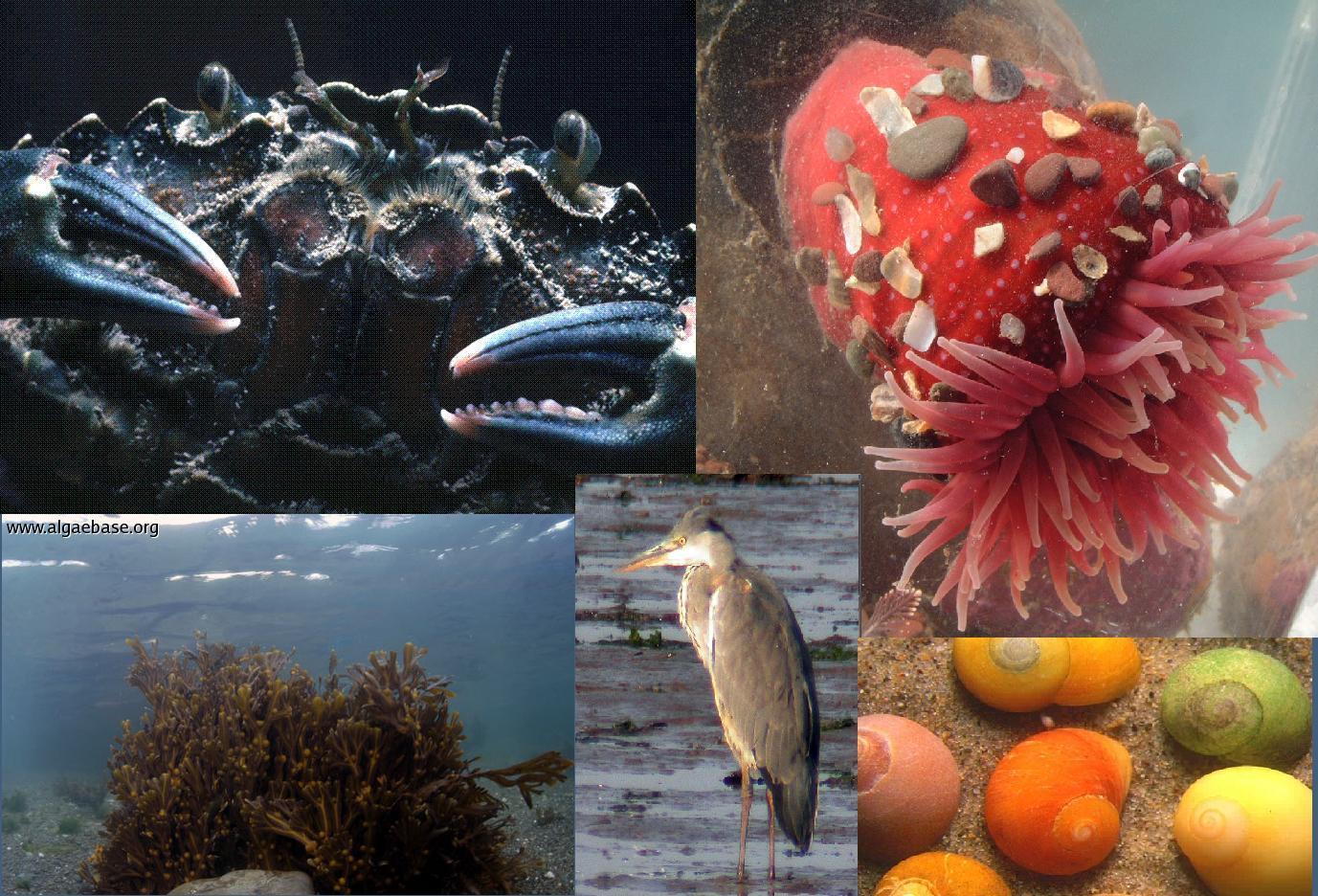
1) Ballantine, 1961, A biologically-defined exposure scale for the comparative description of rocky shore, Field Studies Journal, FSC Council Publications Vol 1(3) 17.
2) Dale Fort Field Centre
3) Ordnance Survey
4) Ballantine, 1961, A biologically-defined exposure scale for the comparative description of rocky shore, Field Studies Journal, FSC Council Publications Vol 1(3) 17.
5) Ballantine, 1961, A biologically-defined exposure scale for the comparative description of rocky shore, Field Studies Journal, FSC Council Publications Vol 1(3) 17.
6) Dale Fort Field Centre, algaebase.org and Marlin website
Ballantine W., 1961, A biologically-defined exposure scale for the comparative description of rocky shore, Field Studies Journal, FSC Council Publications Vol 1(3) 17.
Cremona, 1988, A Field Atlas of the Seashore
Seamounts are common topographic features in the EEZ of the Azores. The archipelago of the Azores is composed of 9 volcanic islands distributed in 3 groups in the north-eastern Atlantic. The size of the Azores EEZ is about 1 000 000 km2, with an average depth of about 3,000 meters. The large occurrence of seamounts is imputable to the volcanic and tectonically active seafloor, typical of this region.
A total of 63 large (height exceeding 1000 meters) and 398 small (height comprised between 200 and 1000 meters) seamounts have been described in the Azorean EEZ, with a density of 3.3 peaks per 1000 km2 and a mean abundance of 0.42 and 0.07 small and large seamounts, respectively, per 1000 km2. Most of the seamounts have deep summits, between 800 to 1500m.
The Azorean seamounts ecosystems are of considerable biological interest and are extremely important also at the economic and, indirectly, social level.
They are hotspots of marine life: shallow seamounts act as aggregating sites for some marine predators.
The fish skipjack (Katsuwonus pelamis), bigeye tuna (Thunnus obesus), the common dolphin (Delphinus delphis) and the Cory’s shearwater (Calonectris diomedea borealis) have been recorded to be more abundant close to some shallow water seamount summits (shallower than 400 m depth).
This footage from Nick of the Film Company shows an example of the chiaroscuro technique, where the relationship between light and dark is defined.