
As a special event for the One Ocean Science Congress, For the Ocean – this Scientific Opera event in Nice Opera House was really unique blend of art, music and science. First of its kind to my knowledge! History was made!
#OneOceanScienceCongress
As a special event for the One Ocean Science Congress, For the Ocean – this Scientific Opera event in Nice Opera House was really unique blend of art, music and science. First of its kind to my knowledge! History was made!
#OneOceanScienceCongress
🌊🌊🌊 Join us for the One Ocean Science Congress in Nice, France from 3rd to 6th June 2025, a Special Event of the 3rd United Nations Conference on the Ocean Endorsed by the United Nations Decade of Ocean Science for Sustainable Development. I will be presenting a poster at stand P193 and co-author of two abstracts.
👇🏽Habitat Suitability Modelling of Blue Carbon Habitats in Southeast Asia by Joshi et al. 🔗https://lnkd.in/ejfNDEBN
👇🏽Developing a framework for co-creating blue carbon policy in southeast Asia by Vu Hoang et al. 🔗https://lnkd.in/e6WEvjFM
👇🏽Future Directions for Deep Ocean Climate Science and Evidence-Based Decision Making by Pillar et al. 🔗https://lnkd.in/eJexq8Rg


Spending January at the Umeå Marine Science Centre (UMF), I was pleasantly surprised by the frozen sea and sub-zero temperatures. Even if it had been described to me before, it was still a unique experience to face the new year of 2025. Some views from the sunrises and sunsets and the frozen Gulf of Bothnia (which separates Sweden and Finland). The centre – known as UMF – specialises in research into Arctic environments as well as a diverse portfolio of international research from around the world; including the blue carbon in southeast Asia project, phytoplankton dynamics, chemical oceanography, research into coral reefs in Mayotte (Indian ocean) and multidisciplinary aspects across a range of marine science and social science disciplines. Coralline algal research is also a key research focus and views from the office window are a constant source of inspiration in the unique environment of the sub-Arctic. The centre has its own hovercraft which specialises in going on the frozen Gulf of Bothnia as well numerous vessels.

The region has a large temperature range across the year of over 60 degrees C and the impacts of climate change can be felt quite intensely in this part of the world. The region is experiencing milder temperatures than previous winters and effects can be felt most prominently near the coastal areas, (in contrast to the nearby mountains). This affects the movement of reindeer and indigenous communities in the region.

My experience of the outdoors has been challenging- having not seen so much snow outside of the mountain ranges. I am very thankful to those who helped me brave the outdoors- especially those icy conditions!!! Special thanks to Dr. Heidi Burdett for lending me some-much-needed-spikes for my snow boots! Stay tuned for some updates about our project, perspectives and more over the coming year. Learn more about UMF at their webpage:
https://www.umu.se/en/umea-marine-sciences-centre
and the Department of Ecology and Environmental Science (EMG) at Umeå University:
https://www.umu.se/en/department-of-ecology-and-environmental-science
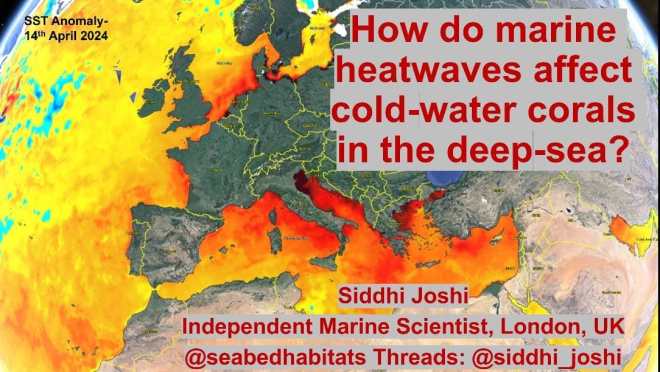
Ocean temperature plays an important role in governing the biophysical environment and in turn the realized ecological niche of benthic organisms and the distribution of marine habitats in the global ocean. As a result of anthropogenic-induced climate change Marine Heat Waves (MHWs) have resulted in widespread coral bleaching and mass mortality of tropical corals. Comparatively little is known about the impact of sub-surface MHWs on cold-water coral communities in the deep-sea, which lack the dependence on symbiotic zooxanthellae of their tropical cousins in surface waters. This study aims to address this deep-ocean knowledge gap utilising numerical modelling.
Previous studies have shown that prolonged and intense sub-surface MHWs and their cumulative intensity results in increasing thermal stress encountered by benthic organisms in depths down to 2000m. This study utilises hydrodynamic modelling outputs of reanalysis data to study impacts of sub-surface MHWs on cold-water corals. With intensification and duration of sub-surface MHWs predicted to rapidly increase in this century, it will increase the thermal stress experienced by cold-water corals and associated communities in the deep-sea.
It is hypothesized that through increased stratification and increased mixed layer depth due to increased storminess and deepening of the thermocline, cold-water coral distribution will be impacted physically (mechanically), however their mortality is more likely to be dependent on food availability and oxygen supply. Preliminary results support this hypothesis in the North Atlantic, indicating that although the cold-water corals may be resilient to thermal stress physiologically, the resulting physically dynamic environment will lead to secondary impacts at the local scale in the benthic boundary layer. Furthermore, oxygen saturation has been found to decrease with increasing temperature and is likely to have a secondary impact on cold-water coral health. This study demonstrates how numerical modelling can provide quantitative spatial and temporal information of biophysical interactions to inform marine habitat mapping studies and species distribution models of habitat suitability.
(Background: This is my research abstract made for the GeoHab 2024 conference – if you would like to learn more, my short oral presentation will be happening on Thursday 9th May 2024 at 1415 in Arendal, Norway. More information about the conference, including how to be a virtual participant, on the official conference website. An interesting program!) See also: https://www.marineheatwaves.org
New update: Marine Heat Waves Shiny App!!
NeMO-Net is a single player iPad game where players help NASA classify coral reefs by painting 3D and 2D images of coral. Players can rate the classifications of other players and level up in the food chain as they explore and classify coral reefs and other shallow marine environments and creatures from locations all over the world!
http://nemonet.info/