

We would like to invite you to a seminar on Seafloor Geomorphology in Galway on Friday 23rd September at 12 noon at the MRI Annex lecture theatre, National University of Ireland, Galway. All welcome!

We would like to invite you to a seminar on Seafloor Geomorphology in Galway on Friday 23rd September at 12 noon at the MRI Annex lecture theatre, National University of Ireland, Galway. All welcome!
Happy World Oceans Day 2016! This year for World Oceans Day (8th June) we have prepared a special World Oceans Day Quiz! Some answers can be found dotted around this blog, with others about topical issues affecting the oceans today. Try the quiz today and test your knowledge of the oceans and its habitats!

 Rhodolith beds (© Rodrigo L. de Moura)
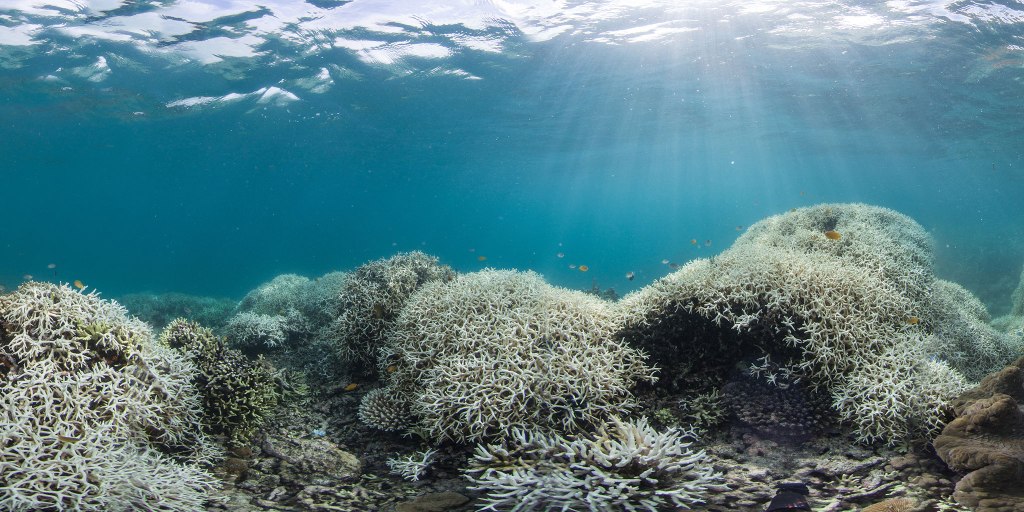 Coral Bleaching Photograph by XL Catlin Seaview Survey Copyright of National Geographic reproduced for Educational Use only
Prof. Iain Stewart of University of Plymouth speaks about communicating geology in his guest lecture at NUI Galway, organised by Earth and Ocean Science Discipline, Galway Earth and Ocean Society and Galway Geological Association. More information about the lecture can be found on the GGA website.

“We live in a scientific age; yet we assume that knowledge of science is the prerogative of only a small number of human beings, isolated and priest-like in their laboratories. This is not true. The materials of science are the materials of life itself. Science is part of the reality of living; it is the what, the how, and the why of everything in our experience. It is impossible to understand man without understanding his environment and the forces that have molded him physically and mentally. The aim of science is to discover and illuminate truth. And that, I take it, is the aim of literature, whether biography or history or fiction. It seems to me, then, that there can be no separate literature of science. My own guiding purpose was to portray the subject of my sea profile with fidelity and understanding. All else was secondary. I did not stop to consider whether I was doing it scientifically or poetically; I was writing as the subject demanded. The winds, the sea, and the moving tides are what they are. If there is wonder and beauty and majesty in them, science will discover these qualities. If they are not there, science cannot create them. If there is poetry in my book about the sea, it is not because I deliberately put it there, but because no one could write truthfully about the sea and leave out the poetry.”
– Rachel Carson during her acceptance speech of the Non fiction award at the National Book Award 1952
Rachel Carson’s second book in the sea trilogy; “The Sea Around Us” is a classic work published in 1951. Described as one of the most successful books written about the natural world, this is a poetic narrative about the life history of the oceans. The Gray Beginnings shares with us the shadowy, primeval beginnings of the Earth and its early environment, exploring the geological theories as well as the evolutionary milestones throughout the history of life. The Pattern of the Surface starts off at the surface waters of the oceans and wonderful world of the plankton- wandering through the interlocking food webs and seas of the world. The Changing Year poetically talks about the changing realm of the sea; the response of marine life through day and night; seasons; and years.The Sunless Sea is about the history of deep sea exploration and Hidden Lands discusses early hydrographic surveying to chart the depths of the continental shelf. The Long Snowfall details the phenomenon of marine snow and Globigerina oozes. The Birth of an Island and The Shape of the Ancient seas ends the Part One entitled Mother Sea.
The Restless Sea begins with Wind and Water a poetic narrative about the life history of the waves and coastal seas, leads on to Wind, Sun, and the Spinning of the Earth; about ocean currents and their oceanographic discovery. The Moving Tides looks at the tidal rythms and the intertidal creatures. Part Three about Man and the sea about him starts off with The Global Thermostat looks at the close relationship between climate and the pattern of ocean circulation. Wealth from the Salt Seas looks at the minerals in seawater and The Encircling Sea starts off with a quote from Homer and the Ancient Greek view of the ocean. With an Afterword updating some of the science by marine biologist Jeffrey Levinton, this book is an imaginative and sensitively emotional account of the sea around us. An absolute joy to read!

We are pleased to announce that a screening of “Maerl: A Rare Seabed Habitat” will take place at the Ryan Institute, National University of Ireland, Galway on Wednesday 14th October at 7pm. This event has been organised by the NUIG Zoological Society. All welcome to attend!
This week I attended the Estuarine and Coastal Science Association conference- ECSA55 in the Docklands, London. The theme of the conference was “Unbounded boundaries and shifting baselines”- a theme relevant to the changing seas of modern times. The plenary sessions were all very interesting and covered different perspectives to coastal sciences and management. As discussed in the maerl documentary, maerl beds will disappear from their northern range, with kelp disappearing from their southern range. More technical sessions on hydrodynamic- sediment transport modelling ran alongside scientific sessions and a diverse range of disciplines were represented. Having visited the Coral Reefs exhibition at the Natural History Museum in the same visit, the session on the Great Barrier Reef was especially interesting. The water quality at the Great Barrier Reef over the last decade is a major threat to the ecosystem. I have been working on a paper about for submission to the Estuarine, Coastal and Shelf Science journal and the early career workshop by Elsevier on publishing in scientific jorunals was very useful. Delegates came from all around the world and the most enjoyable conference dinner was aboard the Elizabethan on the River Thames! The river cruise went from Tower Bridge to Westminister to Greenwich and back to Tower Pier. I was pleased to see friends and collegues from my undergraduate and masters days and meet new ones as well! Here are some of the collection of tweet scientific highlights from the conference.
#ECSA55 Unbounded boundaries and shifting baselines – Estuaries and coastal seas in a rapidly changing world 🌍 pic.twitter.com/lBYXBTNgiD
— Seabed Habitats (@seabedhabitats) September 6, 2015
#ECSA55 Ecosystem services provided by blue carbon ecosystems #mangroves #Saltmarshes #seagrasses #tidalmarshes pic.twitter.com/bRZ9QuJVaQ
— Seabed Habitats (@seabedhabitats) September 6, 2015
Maerl beds from their northern range will disappear with kelp disappearing from their southern range #ECSA55 #seaweed pic.twitter.com/bA3BQZ411j
— Seabed Habitats (@seabedhabitats) September 6, 2015
Modelling Hydro-morphodynamics of small estuaries #ECSA55 pic.twitter.com/yk6Z80nvlx
— Seabed Habitats (@seabedhabitats) September 7, 2015
Multibeam surveying with the Port of London Authority #sandwaves #ECSA55 pic.twitter.com/kj5q7a3zUq
— Seabed Habitats (@seabedhabitats) September 7, 2015
Continue reading “ECSA55 – Estuarine and Coastal Sciences Conference, London”