

How long is the coastline of Australia? One estimate is that it’s about 12,500 km long. However the CIA world factbook puts the figure at more than double this, at over 25,700 km. How can there exist such different estimates for the same length of coastline? Well this is called the coastline paradox. Your estimate of how long the coastline is depends on the length of your measuring stick – the shorter the measuring stick the more detail you can capture and therefore the longer the coastline will be.
Fractals are typically self-similar patterns that show up everywhere around us in nature and biology. The term “fractal” was first used by mathematician Benoit Mandelbrot in 1975 and used it to extend the concept of theoretical fractional dimensions to geometric patterns in nature, including the seabed.
Videos
This year at the Beneath the Waves Film Festival, the short film Mikono ya Wavuvi meaning “In Fishermen’s Hands” won the People’s Choice Award. “Coral reefs are one of the most biodiverse ecosystems in the world, and globally, millions of people depend on the resources they provide. In East Africa, along the coast of Kenya, fishing is often the only option for work, and as a result, communities are highly reliant on coral reefs for food and livelihood. This has resulted in increasingly degraded coral reefs, where very few fish remain and sea urchins take over. Consequently, some fishermen have identified a need for change. This has resulted in an exciting movement for the establishment of community-managed areas closed to fishing, locally called a “tengefu”, which is a Swahili term meaning “to set something aside“. This is a short film about marine conservation in Kenya and the struggle between fishermen saving the ocean or saving their livelihood.”
via Mikono ya Wavuvi (In Fishermen’s Hands) on Vimeo.
“The Beneath the Waves Film Festival aims to encourage, inspire, and educate scientists, advocates, and the general public to produce and promote open-access, engaging marine-issue documentaries. The goal is to facilitate widespread science communication by bringing together marine films from around the world for open discussion, while also providing hands-on educational opportunities for researchers interested in film and media outreach.”
via Beneath The Waves Film Festival.
Further Links
Mikono ya Wavuvi Facebook page
Beneath the Waves Facebook page
A hydrothermal vent is a fissure in a planet’s surface from which geothermally heated water issues. Hydrothermal vents are commonly found near volcanically active places, areas where tectonic plates are moving apart, ocean basins, and hotspots. Hydrothermal vents exist because the earth is both geologically active and has large amounts of water on its surface and within its crust. Common land types include hot springs, fumaroles and geysers. Under the sea, hydrothermal vents may form features called black smokers. Relative to the majority of the deep sea, the areas around submarine hydrothermal vents are biologically more productive, often hosting complex communities fueled by the chemicals dissolved in the vent fluids. Chemosynthetic archaea form the base of the food chain, supporting diverse organisms, including giant tube worms, clams, limpets and shrimp.
The Endeavour Mid-ocean Ridge is an exciting study location because it is a place where new volcanic seafloor is constantly created at the spreading boundary between the Juan de Fuca and Pacific plates. The region (approximately 300 km off the British Columbia coast), has been the site of intensive investigation for more than 20 years.The Ocean Networks Canada Observatory, comprising VENUS and NEPTUNE Canada cabled networks, supports transformative coastal to deep ocean research and technology. It enables real-time interactive experiments, focused on ocean health, ecosystems, resources, natural hazards, and marine conservation. The Observatory is a national facility led by the University of Victoria for a pan-Canadian consortium of universities and partners.
NEPTUNE Canada’s real-time monitoring capability will benefit both ongoing and new experiments. Continuous data gathered before, during and after events like earthquakes and intrusions will be recorded across a coordinated suite of instruments both at the hydrothermal vents on the seafloor and within moorings extending 250m up into the 2,200m water column. A network of seismometers here and at other sites will provide high resolution information on tectonic processes such as earthquakes and strain across the Juan de Fuca plate.
via NEPTUNE Canada: Endeavour and Wikipedia.
Some more footage of the Endeavour ridge hot vents acquired using the ROPOS ROV. See also the BBC news report about a recent British expedition to the Cayman Trough to the deepest undersea vents.
The Fleur de Passion is navigating in the Wadden Sea. The goal of the Changing Oceans Expedition is to gather information on best practices of these marine protected areas, which have been classified world heritage by the UNESCO in June 2009. This will complete the information gathered earlier in the expedition and will help to develop a global strategy for decreasing the impact of human activities on the oceans. Learn more about the Changing Oceans expedition at their website.
Farraigí na hÉireann is an Irish marine science documentary currently being broadcast on TG4, Ireland’s Irish language TV channel. Almost two years in the making, this is the first Irish Ocean wildlife series to be broadcast and is very unique in that it was predominantly filmed underwater around Ireland. Farraigí na hÉireann was produced entirely in Ireland for TG4 by independent Irish production company Sea Fever Productions from Lahinch in Co. Clare. TG4 are showing ‘Farraigí na hÉireann’ on Tuesday. Feb. 19th at 8pm and then the same time every week for six weeks. Tonight it is the second episode about the seabed! You can watch it on the TG4 Player under the “documentaries” tab, if it is available in your country.
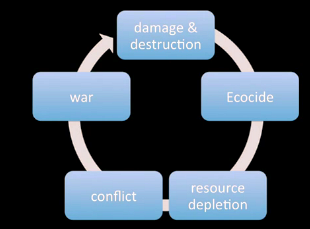
British earth lawyer Polly Higgins discusses whether the Earth is in need of a good lawyer and whether ecocide, the extensive damage, destruction or loss of an ecosystem, should be considered a crime. The concept of creating an international crime of ecocide has actually been around since the 1970s. Although this seems like a radical idea at first, Polly Higgins argues widespread destruction of the environment is leading to resource depletion, which leads to conflict, which can then lead to war, which of course leads to more damage and destruction and more resource depletion.
Ecocide is already considered a national crime in Georgia, Armenia, Ukraine, Belarus, Kazakhstan, Kyrgyzstan, Moldova, Russian Federation, Tajikistan and Vietnam. Further discussion about her argument can be found in a UK newspaper article and the eradicating ecocide campaign. The Guardian newspaper also lists the top 10 ecocides in pictures.