Cold water corals, carbonate mounds and ocean currents

Coral reefs are usually associated with warm, tropical waters and exotic fish, but not with the cold, deep and dark waters of the North Atlantic where corals were regarded as oddities on the seafloor. It is now known that cold-water coral species also produce reefs, which may rival their tropical cousins in terms of the species richness of associated marine life. Increasing commercial operations in deep waters, and the use of advanced offshore technology have slowly revealed the true extent of Europe’s hidden coral ecosystems. The discovery of extraordinary, 10 km-long chains of the reef-building corals Lophelia pertusa and Madrepora oculata in several hundred metres of water on the Norwegian and Irish Shelves have deeply challenged conventional views. The same coral assemblages are also found associated with large seabed structures in the Porcupine Seabight (offshore Ireland), where they are so abundant that their skeletal remains have, over the millennia, contributed to carbonate mound structures up to 300m high in 700-1200m water depths. The potential of cold-water corals to contribute to the formation of these large seafloor features and their high biological diversity have attracted considerable public attention through reports in numerous national TV and newspaper features.

via University of Liverpool

Coinciding with World Oceans Day, Prof. David van Rooij, Renard Centre of Marine Geology (RCMG), Dept. of Geology and Soil Science, Ghent University, Belgium gave a seminar today in Galway, entitled “Go with the flow: Impact of the Mediterranean Outflow Water (MOW) on NE Atlantic sedimentary processes and ecosystems.” The talk particularly focused on the colonisation of Atlantic margins by cold-water corals since the end of the last Ice Age and how variation in the MOW explains the current distribution pattern of carbonate mounds found, for example, in Irish waters. See also the Lophelia.org website for some more background on cold water corals and carbonate mound provinces.

Acknowledgements

Special thanks go to Prof. David van Rooij for permission for inclusion of his seminar in this blog.

Image Credit

1) Map of some carbonate mound provinces in North East Atlantic, University of Liverpool.

And finally:

Changing Oceans Expedition

The Changing Oceans Cruise is a 35 day scientific expedition, departing from Glasgow on the 17th May 2012. Led by Professor Murray Roberts, the mission is to examine the potential impact of changes in the temperature and chemistry of the oceans on cold-water coral reefs and the associated reef-creatures. Using a remotely-operated vehicle ROV, we will survey and sample the deep water coral communities. We will also use a vast array of scientific equipment to study the biology, chemistry and physics of cold-water coral sites, as well as conducting onboard experiments.

via Changing Oceans: About.

Check out this amazing cruise blog at Changing Oceans. Especially interesting are the Equipment and Sea Creatures Sections. Sorry about the absence from blogging in the last month or so; have been busy with work. Still, have got a few potential posts lined up for next month and am considering becoming a filmmaker…

The Secret Life of Plankton

New videography techniques have opened up the oceans’ microscopic ecosystem, revealing it to be both mesmerizingly beautiful and astoundingly complex. Marine biologist Tierney Thys teamed with Christian Sardet (CNRS/Tara Oceans), Noé Sardet and Sharif Mirshak to use footage from the Plankton Chronicles project to create a film designed to ignite wonder and curiosity about this hidden world that underpins our own food chain.

Stay tuned as Dr. Tierney Thys is going to be giving a talk at the Ryan Institute, Galway, this week. See also the website Plankton Chronicles for amazing videos of plankton.

Mangroves


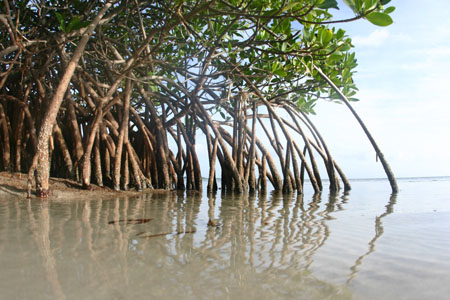
Mangrove forests and swamps are saline, coastal habitats found in tropical and sub-tropical hot, wet areas. Together with saltmarshes, mangrove forests are a place where vascular plants can be found dominating in the marine environment.  Mangroves are large shrubs or trees up to 45m in height, amongst the most productive and biologically complex ecosystems on Earth (Barnes and Hughes, 2002). Mangroves support unique and diverse ecosystems of bird, monkeys, kangaroos and snakes and crocodiles,  fish, shellfish, tree climbing crabs and bees to name a few (National Geographic). Often found intertidally and protected from high-energy wave action, the trees have aerial roots and trunks which reduce the local water velocity and act as sediment traps. In a similar way to saltmarshes, mangroves  raise the level of the shore and  help to stabilise the land. Mangroves forests are filled with creeks and channels in densely vegetated areas.

Mangrove plants require a number of physiological adaptations to overcome the problems of anoxia, high salinity and frequent tidal inundation. Each species has its own solutions to these problems; this may be the primary reason why, on some shorelines, mangrove tree species show distinct zonation. Small environmental variations within a mangal may lead to greatly differing methods for coping with the environment. Therefore, the mix of species is partly determined by the tolerances of individual species to physical conditions, like tidal inundation and salinity, but may also be influenced by other factors such as predation of plant seedlings by crabs.

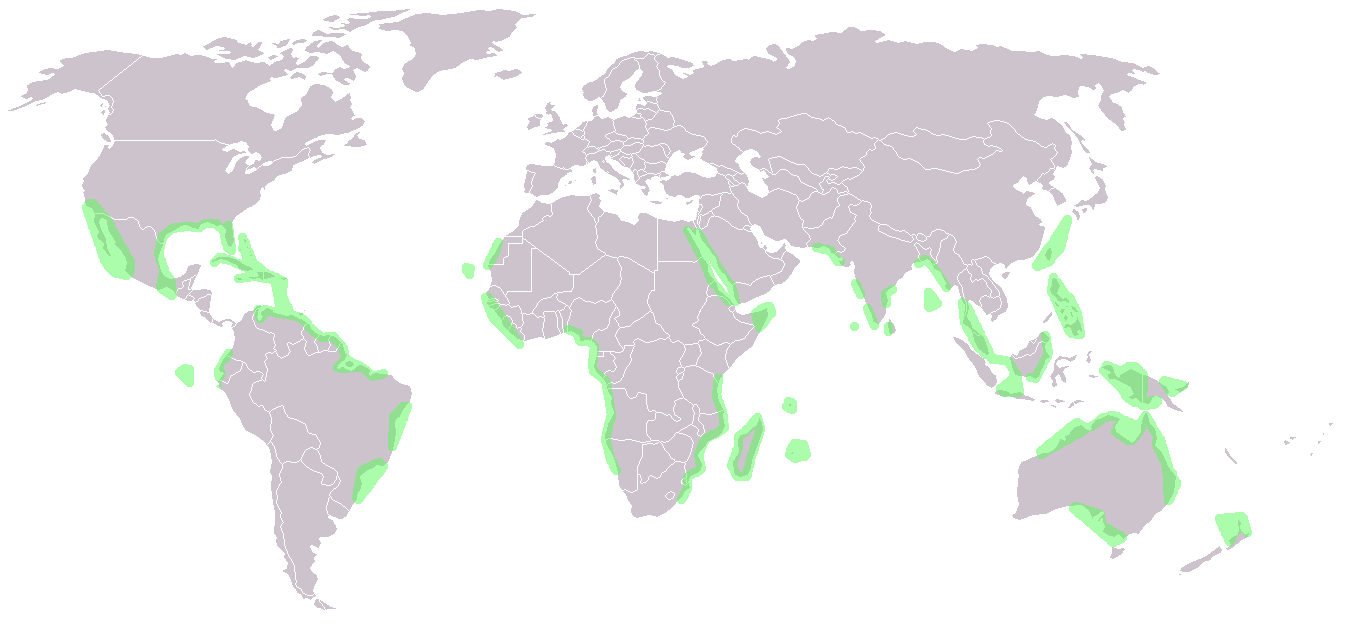
The worldwide distribution of mangroves is shown on the map below:And diving the mangroves:

Image credits

1) Mangrove forests of Belize, Copyright of National Geographic reproduced for Educational Use only

2) Wikipedia article on Mangrove

3) Wikipedia article on Mangrove

References

1) Barnes and Hughes, 2002,  An Introduction to Marine Ecology

2) National Geographic website

3) Wikipedia article on Mangrove